Best Panoramic Views in Prague for a Scenic City Walk
A scenic Prague walking route connecting hilltop viewpoints, river panoramas, historic rooftops, and useful stops for photographing the city.
A scenic Prague walking route connecting hilltop viewpoints, river panoramas, historic rooftops, and useful stops for photographing the city.
Prague is a strong city for panoramic walking because many of its best views are connected by parks, bridges, towers, and sloping streets. Early May is a good time to plan this route. The city is busy, but the weather is usually easier for walking than high summer, and spring greenery softens the view over the Vltava River, red roofs, and church towers.
Start with Petřín Hill if you want the widest view. Petřín Tower was built for the 1891 Jubilee Exhibition and was inspired by the Eiffel Tower at a smaller scale. Prague’s official tourism site notes that the tower is 58.70 metres high and has 299 steps to the top, where visitors can see across the city and, on a clear day, much farther. See Prague.eu’s Petřín Tower guide for background.
Petřín works best as a morning viewpoint. The park setting lets you begin slowly instead of starting in the busiest part of the old town. From the hill, Prague’s layout becomes easier to understand: the castle area, the river bends, the bridges, and the old town are all visible in relation to each other. This makes it a useful first stop for readers who want more than isolated photo spots.
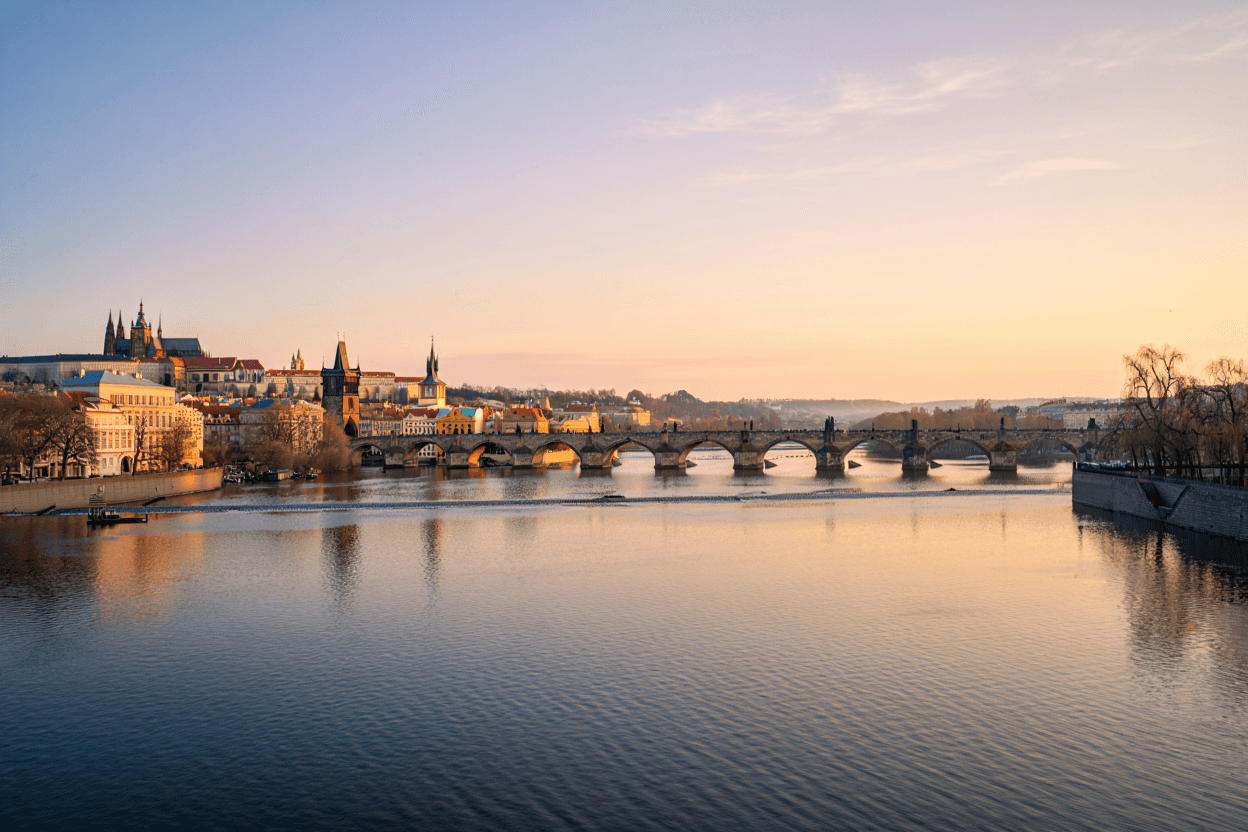
From Petřín, walk down toward Malá Strana and continue toward Charles Bridge. The bridge itself is not a high viewpoint, but it is one of the best places to read the city at human scale. Early morning gives cleaner compositions because crowds are lighter. If you arrive later, focus on details instead of trying to capture an empty bridge. Statues, tower arches, reflections, and river traffic all help tell the story of the route.
The Old Town Bridge Tower gives a tighter and more architectural view. It is useful because it looks back along Charles Bridge toward the castle. This is one of Prague’s strongest framed views: stone bridge, people movement, river, and hilltop skyline in one direction. It also teaches an important photo principle. Sometimes the best viewpoint is not the highest one, but the one that organizes the scene most clearly.
Letná Park is the next practical stop. It gives a famous view over the Vltava bridges, especially from the area near the metronome and nearby terraces. This is where Prague becomes graphic: repeated bridges, river curves, tram lines, and dense rooftops. Late afternoon can work well here because the city gains depth as the light drops. It is also a good place to pause instead of rushing from tower to tower.
For a quieter option, add Vyšehrad. It is south of the old town and gives a different, less crowded view over the river. The fortress area, cemetery, church, and park paths make it a slower visual route. It is especially useful for readers who want to avoid staying only inside the central tourist loop.
If you are building a wider spring city series, Prague pairs well with the compact Slovenian routes already covered in Ljubljana viewpoints and Lake Bled photo spots. All three articles teach the same idea at different scales: a good visual guide connects viewpoints into a walk, not a random list.
The best Prague panorama plan is simple: Petřín for the wide overview, Charles Bridge for street-level movement, the Old Town Bridge Tower for structure, Letná for the bridge sequence, and Vyšehrad if you want a calmer finish. Prague rewards people who walk with the river instead of only chasing the most famous tower.