Venice Photo Spots Beyond St Mark’s Square
A photography-focused Venice guide featuring quieter canals, bridges, waterfront views, neighborhood streets, and useful morning and evening light.
A photography-focused Venice guide featuring quieter canals, bridges, waterfront views, neighborhood streets, and useful morning and evening light.
St Mark’s Square is central to Venice, but it is not enough to explain the city visually. The strongest photo route moves between open water, narrow canals, working neighborhoods, bridges, and higher perspectives. Venice is also a place where route discipline matters: a short distance can involve several bridges, crowded bottlenecks, and repeated dead ends. Plan a sequence rather than collecting unrelated pins.
Riva degli Schiavoni provides a broad opening view across the San Marco Basin toward San Giorgio Maggiore. Early morning offers the cleanest light and more space, although delivery activity and commuters are part of the real scene. Move east from the busiest area rather than remaining directly beside the Bridge of Sighs.
The official Venezia Unica itinerary through Castello highlights waterfront views over the basin, San Giorgio Maggiore, and the Lido. Its route is useful because it continues into a district with naval history, residential streets, and gardens instead of returning immediately to the same central landmarks. See the official Castello walking itinerary for route context.
The island of San Giorgio Maggiore reverses the usual composition. Instead of photographing the church from St Mark’s waterfront, you look back toward the Doge’s Palace, campanile, and long façade of the city. The vaporetto crossing is short, but allow time for queues and service changes.
A higher view from the campanile can show the basin, Giudecca, and central Venice in relation to each other. Check current opening information before planning around it. From ground level, the waterfront still offers a strong panorama, especially when boats create movement in the foreground.
The view toward Santa Maria della Salute from Ponte dell’Accademia is famous, yet it remains valuable because the canal bends naturally through the frame. Morning and late afternoon give different light, but no time guarantees an empty bridge. Keep moving, avoid blocking the central walkway, and use a handheld setup rather than spreading equipment across the crossing.
After photographing the wide view, continue into Dorsoduro. The district offers quieter canals, small squares, and low waterfront perspectives. This creates a better sequence than taking the bridge image and returning immediately to San Marco.
Walk toward Zattere for open views across the Giudecca Canal. The long waterfront provides space to photograph boats, industrial forms, church façades, and changing weather. Continue toward Punta della Dogana, where the Grand Canal and Giudecca Canal meet. The triangular point gives a low, open perspective toward San Marco and San Giorgio.
This area is exposed, so wind and bright reflected light can be strong. In midday sun, use architectural shadows and details rather than forcing a flat panorama. Evening often brings softer light, but the route remains worthwhile in cloud because the water and pale façades retain structure.
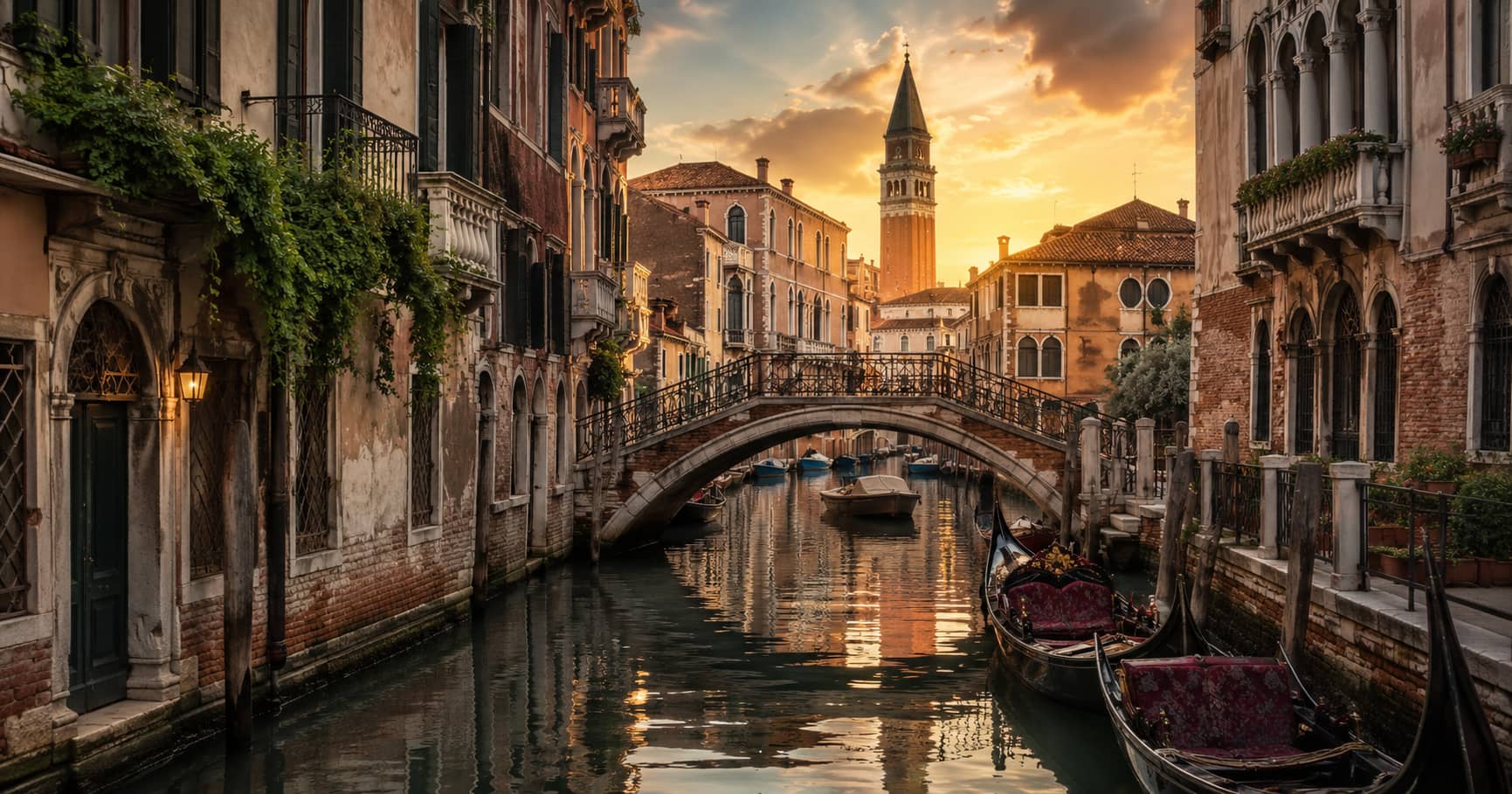
Rialto is an obvious stop, but smaller bridges often produce more readable scenes. Look for canals with a clear bend, a visible footbridge, and enough depth between foreground and background. Delivery boats, residents, and maintenance activity are not visual problems. They show how the city functions.
Do not enter private courtyards, sit on residential steps, or block narrow entrances. Venice’s most attractive compositions often appear in spaces that remain essential to local movement. A good travel-photography guide should protect that use rather than encouraging visitors to occupy it.
Use one strong foreground element, such as a mooring post, bridge arch, or boat. Let the canal lead toward a brighter background. Keep vertical lines controlled when photographing close façades, and wait for boat movement to create scale. A wide lens can exaggerate narrow spaces, while a normal focal length often produces a more natural view.
Continue east toward the Arsenale and then farther into Castello. The monumental entrance, brick walls, broad canals, and quieter residential streets add a different visual language. Near Via Garibaldi and the gardens, Venice opens into wider spaces that feel separate from the compressed lanes around Rialto.
This section is especially useful in August, when the central core can feel crowded and hot. The route still requires shade breaks and water, but it allows you to move through less concentrated visitor traffic. Do not describe Castello as empty or unknown; it is a lived district, not a secret backdrop.
Venice walking is more tiring than the flat map suggests because every canal crossing adds steps. In summer, begin early, rest during the brightest hours, and return outside for late light. Carry water, but remember that public space is limited and sitting on bridges or steps can obstruct movement.
If you enjoyed the changing coastal conditions in Madeira’s viewpoint road trip, Venice offers the opposite planning problem. The distances are smaller, but pedestrian flow and water transport determine the route. In both places, flexibility produces better results than a fixed checklist.
Begin on Riva degli Schiavoni, cross to San Giorgio Maggiore, return toward the Accademia Bridge, walk through Dorsoduro to Punta della Dogana, and finish with Castello or the Zattere depending on light. Split the route across two sessions if heat or crowds make the middle of the day inefficient.
Venice becomes more visually coherent when you stop treating every bridge as a separate attraction. Use the lagoon for scale, the Grand Canal for structure, Dorsoduro for open space, and Castello for daily context. St Mark’s Square can remain part of the story without taking over the entire article.